Friday, August 21, 2020

TEXT FEATURES


LANGUAGE STRAND: RESEARCH & STUDY SKILLS

FOCUS QUESTION:

What was Jamaica's Road To Independence?

SPECIFIC OBJ.:

1. Review and use external text features previously learned-headings, sub-headings, bullets, illustrations, italics, etc.


CONTENT SUMMARY

Text features include all the components of a story or article that are not the main body of text. These include the table of contents, index, glossary, headings, bold words, sidebars, pictures and captions, and labeled diagrams. 

Text Feature Project: LAWE-Mrs. Boyd's website


ENGAGE

Students I want you to listen to the rap song below carefully and then tell me what it is all about.


Let's have a discussion on what you were able to glean from the song.

EXPLORE

Now that you know what text features are, let's see if we can identify any other in this chart below.

Text Feature Project: LAWE-Mrs. Boyd's website

Open the link below and let's complete the activity together .


EXPLAIN

Now can you explain what text features are and give some examples?

Ok you may use your Social Studies Text (Jamaica Primary Social Studies) to do this activity.
Turn to chapter 2 of your SS Book.- The Struggle For Independence. 
I want you to scan through the pages and see how many of the different text features you can identify. Be ready to share with your teacher.

Non Fiction Text Features - Lessons - Tes Teach
 

EXTEND/ELABORATE

Choose some of the nonfiction books around the classroom to complete the activity sheet below.

Using Non-Fiction Text Features Worksheet • Have Fun Teaching

EVALUATION

Complete the charts below.
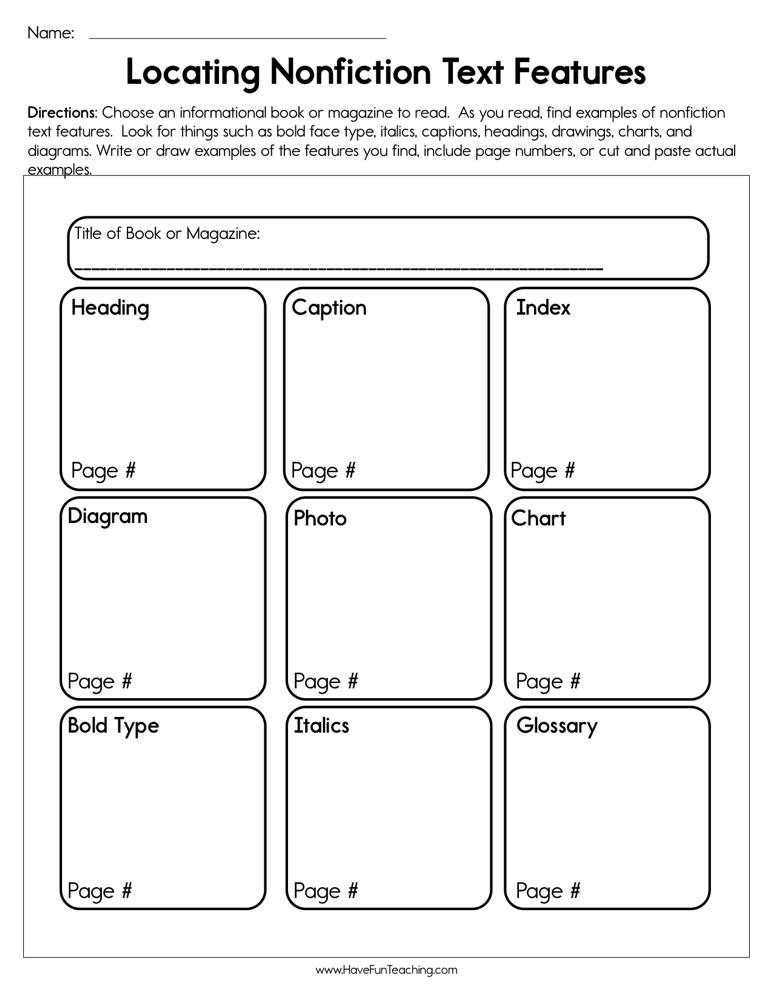

Locating Nonfiction Text Features Worksheet • Have Fun Teaching


FREE Nonfiction Text Features Matching Activity | Nonfiction text ...


Nonfiction Text Features Worksheets | 99Worksheets
FOLLOW UP PRACTICE EXERCISES
Activity 1    drag and drop on appropriate picture
Activity 2     read definition and name text feature defined
Activity 3      name features shown
Activity 4      look at illustration and and answer questions
Activity 5      match words to pictures
Activity 6      drag pictures to text feature box
Activity 7      match text feature to definition
Activity 8       matching activity
Activity 11      multiple choice
Activity 14      drag and drop

Thursday, August 20, 2020

SETS / SUBSETS

FOCUS QUESTION:

What are the special symbols and language I use when I work with sets?


SPECIFIC OBJECTIVE:

1.       Associate the members of a set with the properties of that set. (Subsets)


CONTENT SUMMARY:

SET THEORY


ENGAGE:

Ok students today we will be looking at a new topic in sets. That is SUBSETS. What do you think this means?
Now let's read the dictionary meaning to see if you were correct.

subset
/ˈsʌbsɛt/
noun
plural noun: subsets
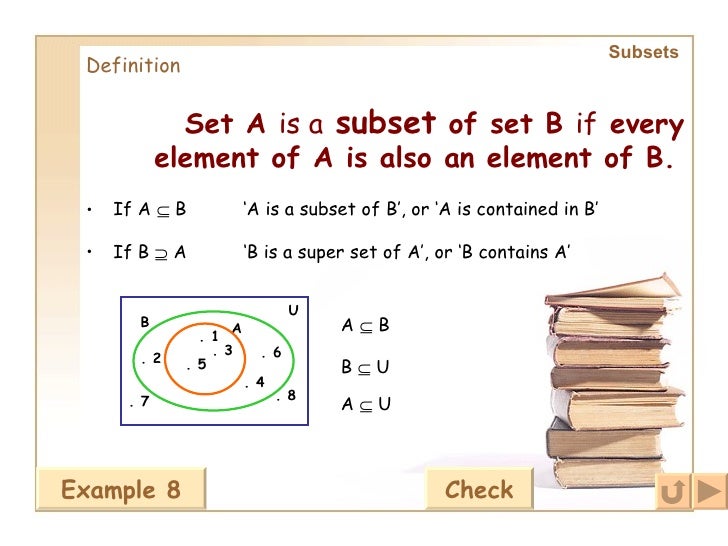
  1. a part of a larger group of related things.
    "computer vendors usually only support a small subset of the disks available"
    • Mathematics
      a set of which all the elements are contained in another set.


EXPLORE:
Now we are going to learn more about the topic. I want you to watch the video clips below.

Watch this video.

Watch this video on subsets to learn more about the topic.

What is your understanding of the clips. Is there anything else you have learned? Do you fully understand what they are depicting?

Now I want you to write all the subsets of the Set P {1, 2, 3}

Well if you got these below, then you are right.

a finite-state auto-Matan — The size of power sets


EXPLAIN:

Now students I want you to explain what a subset is and give me examples.
Differentiate between Proper and Improper subsets.

EXTEND/ELABORATE:

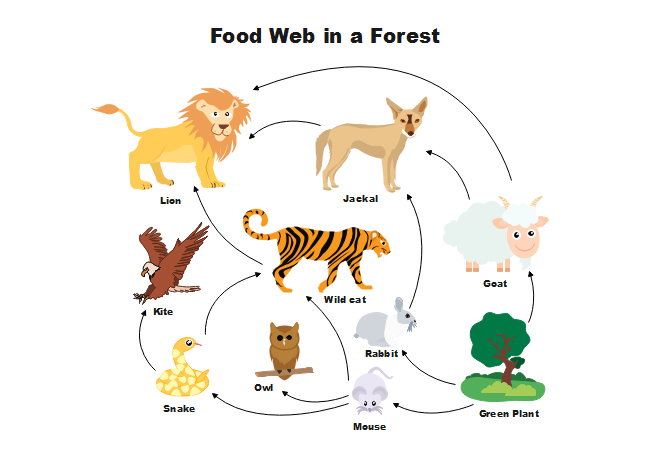
Now students, what do you know about a Food Web?
What is the difference between a Food web and a food chain?

Let's look at  examples of each below.

Food Web Diagram | Free Food Web Diagram Templates

Education Chart Of Biology For Food Web Diagram Royalty Free ...


Food Chain and Food Web - Meaning, Diagrams, Examples - Teachoo


Ecology Flow of Energy in a Food Chain - YouTube

Based on the Food Webs you have seen and the different Food Chains, would you say then that the Food Chain is a subset of the Food Web?
Explain your answer.


EVALUATE:

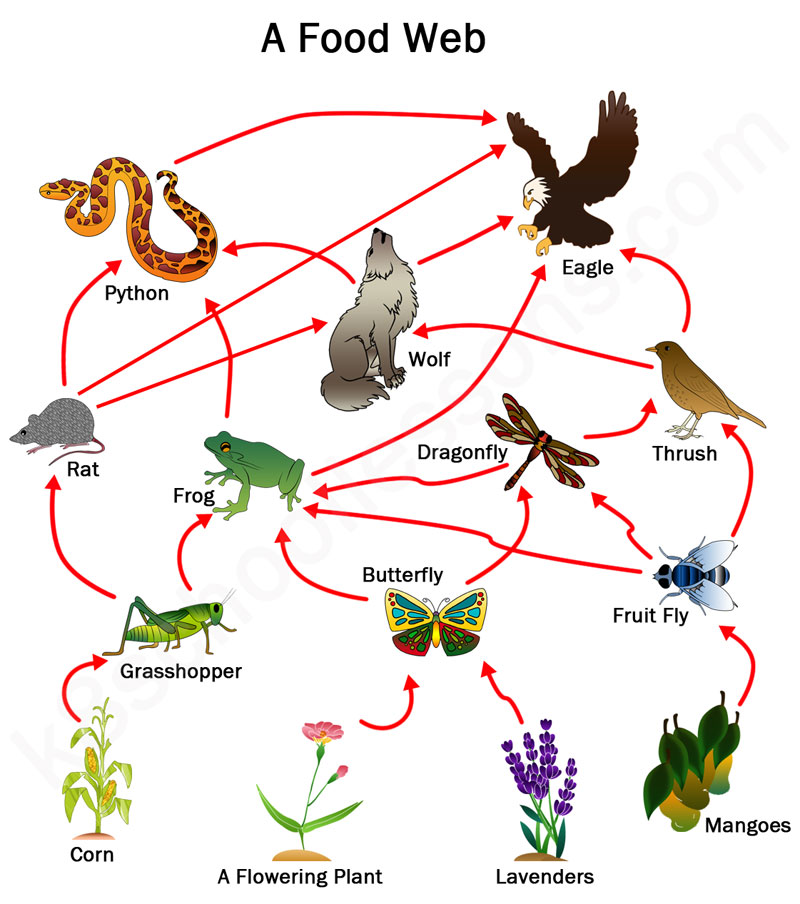
1. Form three (3) subsets from the Food Web below.
Food Chains and Food Webs | Examples of Food Chains and Food Webs

# 2

(A) Consider the Set Y{o, r, w, q}. Form all the subsets of this set. How many did you get?
(B) Group the subsets as Proper and Improper.
 
#3

07 WS1 SETS 2012 Practice worksheet Set Theory- Class vii WS1 SETS ...

#2
Write all the subsets of B{ A, B, C, }


FOLLOW UP PRACTICE EXERCISES

Friday, August 14, 2020

SETS - EQUAL and EQUIVALENT


FOCUS QUESTION:
What are the special symbols and language I use when I work with sets?


SPECIFIC OBJ.
Associate the members of a set with the properties of that set.
(Distinguish between equivalent and equal sets).

CONTENT SUMMARY

Definition of a Set


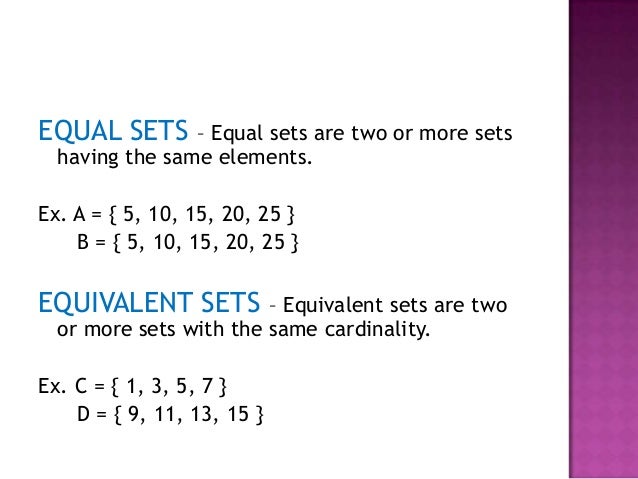
      Equal

       Not Equal

↔️       Is Equivalent

       Not Equivalent


ENGAGE 

Students, I want you to think about two words: EQUAL and EQUIVALENT. What is the meaning of the two words? They are both used to describe sets.
Ok I want you to use your dictionaries to help you.

Let's use the definition from the internet now. Can we read together?

                                 
equivalent
/ɪˈkwɪv(ə)l(ə)nt/
See definitions in:
all
mathematics
chemistry
adjective
  1. equal in value, amount, function, meaning, etc.
    "one unit is equivalent to one glass of wine"
    Similar:
    equal
    identical
    similar
    parallel
    analogous
    comparable
    corresponding
    correspondent
    interchangeable
    like
    commensurate with
    the same as
    synonymous with
    much the same as
    amounting
    tantamount
    approximate
    near
    close
    of a kind
    of a piece
    coequal
    Opposite:
    different
    dissimilar
noun
  1. 1.
    a person or thing that is equal to or corresponds with another in value, amount, function, meaning, etc.
    "the French equivalent of the Bank of England"
    Similar:
    counterpart
    parallel
    alternative
    match
    complement


equal
/ˈiːkw(ə)l/
adjective
  1. 1.
    being the same in quantity, size, degree, or value.
    "add equal amounts of water and flour"
    Similar:
    identical
    uniform
    alike
    like
    the same
    one and the same


Now would you say the two words mean the same?
Lets relate these words to sets. Give me your understanding of the two terms.

EXPLORE

Now I want you to examine the video clip below.

Look at this video clip

Let's do some re-cap now. Read the notes below.

Definition of a Set


EXPLAIN

Now you should be able to differentiate between EQUAL SETS and EQUIVALENT SETS.
Can you now provide examples of each type?

Write the symbols that represent the following.

 equal -----
 not equal _____

 equivalent ______
 not equivalent ____

EXTEND/ELABORATE

You can watch this video clip to glean more information.


EVALUATION

Task # 1

Indicate if the sets below are equal or equivalent.

1. Set A { vowels}
    Set B {a, e, i, o, u}

2. Set R { factors of 8}
    Set M { 1, 2, 4,}

3. Set C {Prime factors of 10}
    Set W {2, 5}

4. Set F { r, p, j, q}
    Set U {5, 9, 7}

5. Set O {odd numbers less than 10}
    Set L  {first 5 counting numbers}

Task #2

Write 3 examples of equivalent sets and 3 examples of equal sets below.


FOLLOW UP PRACTICE EXERCISES
ACTIVITY
ACTIVITY
ACTIVITY
ACTIVITY


Lesson Title: Understanding Equivalent and Inequivalent Sets

Grade Level: 6
Duration: 1 Hour
Strand: Sets
Focus Question: What are the special symbols and language I use when I work with sets?
Objectives:

  1. Associate the members of a set with the properties of that set.

  2. Distinguish between equivalent and equal sets.


🌟 5E Lesson Model Plan

1. Engage (5-7 minutes)

Activity: "Mystery Bag Challenge"

  • Teacher presents two "mystery bags" (physical or virtual) each with 4 random classroom objects.

  • Students describe the objects and determine whether the bags have the same number of items and/or same items.

  • Use this to introduce the terms:

    • Equivalent Sets: Same number of elements.

    • Equal Sets: Same number and identical elements.

❓ Ask: “How can we describe sets that have the same number of items but not the same items?”
🔤 Highlight key vocabulary: Set, element, cardinality, equivalent (∼), equal (=), inequivalent


2. Explore (10-15 minutes)

Activity: “Set Sorting STEM Task”

  • In small groups, students are given a mix of image cards or objects related to STEM themes (e.g., types of energy sources, simple machines, planets, geometric shapes).

  • Students group them into sets based on criteria (e.g., color, type, shape, use).

  • Then they compare sets:

    • Count elements in each set.

    • Use symbols to label:
      A ∼ B (equivalent), A = B (equal), A ≁ B (inequivalent)

Materials: Printed cards or virtual slides with items, Venn diagrams, Set symbol posters.

🧠 Observation: Which sets are equivalent? Which are equal? Which are neither?


3. Explain (10 minutes)

Mini-Lesson + Notes:

  • Define:

    • Set: A collection of distinct objects.

    • Equivalent sets: Sets with the same number of elements. (Symbol: ∼)

    • Equal sets: Sets with the same elements. (Symbol: =)

    • Inequivalent sets: Sets with different numbers of elements. (Symbol: ≁)

  • Use examples from previous activity.

  • Highlight symbols and language used with sets.

💡 Write on board:
Set A = {1, 2, 3}, Set B = {a, b, c}, Set C = {1, 2, 3}
➤ A ∼ B, A = C


4. Elaborate (15 minutes)

Activity: “Set Scenarios - Real-World STEM”

  • Students complete a worksheet with scenarios (see examples below).

  • For each pair of sets, students must:

    1. List the elements.

    2. Determine whether the sets are equal, equivalent, or inequivalent.

    3. Justify with a sentence using appropriate language/symbols.

Example Scenarios:

  • Set A: planets in the solar system | Set B: days of the week

  • Set C: types of energy (solar, wind, thermal) | Set D: {wind, solar, thermal}

🧠 Extension/Challenge: Students create their own sets from a STEM topic (e.g., animals with vertebrae vs. invertebrates) and compare them.

Differentiated Support:

  • Tier 1: Use concrete objects or drawings.

  • Tier 2: Provide sentence starters and vocabulary support.

  • Tier 3: Students create and compare abstract sets independently.


5. Evaluate (10 minutes)

Three-Tier Evaluation Task

TierActivityFocus
Tier 1Match sets with symbols: ∼, =, ≁Recall and identification
Tier 2Complete chart with sets and explain the relationship (equivalent, equal, inequivalent)Understanding and explanation
Tier 3Create 2 original sets: one that is equivalent but not equal, and one that is inequivalent; justify eachApplication and analysis

🌱 STEM Integration

  • Sets drawn from Science (e.g., organs, planets, types of energy), Technology (e.g., devices, apps), Engineering (e.g., simple machines), and Math (e.g., types of angles, polygons).

  • Students are encouraged to apply logical reasoning, categorize, and model their thinking using set notation.


✏️ Materials Needed:

  • Mystery bag items or cards

  • Worksheets/slides

  • Markers, chart paper, or digital whiteboard

  • STEM-themed item cards or images

  • Vocabulary posters with symbols: =, ∼, ≁


🔁 Wrap-Up (2-3 minutes)

  • Recap focus question:
    “What are the special symbols and language I use when I work with sets?”

  • Ask for quick oral examples: “Give me two sets that are equivalent.”

  • Share one new thing they learned today.