Wednesday, May 6, 2020

MIXTURES (Solutions, suspensions, colloids) - Lesson 2

FOCUS QUESTIONWhat is a mixture and how can mixtures be separated?

SPECIFIC OBJECTIVE: 
1.       Classify mixtures as solutions, suspension and colloids


CONTENT

solution suspension and colloid ppt - Google Search | Chemistry ...


Disperse systems. True solution - презентация онлайн


ENGAGE:

Students, I need you to recall what the definition for mixture is based on our last lesson.
How can mixture be defined?
Are all mixtures the same?
Explain your answer using the experiments you performed in the last lesson.

I need you to get your note books ready. We will be learning today about the different types of mixtures, and their characteristics. For this lesson, you will need the following:

3 clear glasses of water
1 tsp salt
1/4 cup flour
1 glass of milk (you may use dry milk)
a flashlight
1 cup garden soil


EXPLORE:


Add water to each of the substances you have secured: (salt, flour, milk) and stir for two minutes. Describe the appearance of the resulting mixture in writing . Share this observation with the class, and in a teacher-led discussion.
For the garden soil, just examine what it is made of. (do not add water to this). Just examine it and determine if it could be considered a mixture just as it is. What does it comprise/made up of?

Based on the experiment, under which heading would you place each activity? Quickly place them on the correct heading. I have done one for you.


Liquid & Liquid                                 Solid & Solid                            Solid  & Liquid

                                                              garden soil


Now let's see what your mixtures look like.
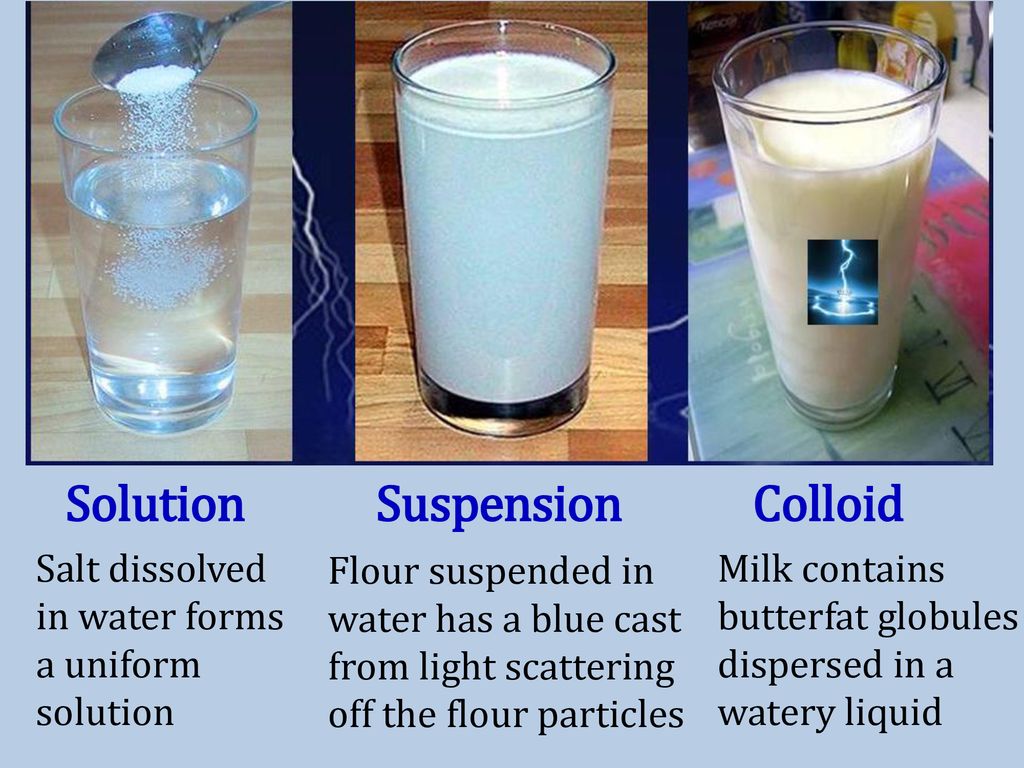
Solutions, Colloids, and Suspensions - ppt download

Now you can arrange the glasses in rows, shine the flashlight on the glasses and demonstrated below.
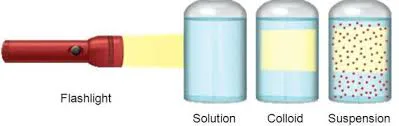
Solutions, Colloids, and Suspensions | Other Quiz - Quizizz

Best Soil for a Raised Bed Vegetable Garden | LoveToKnow garden soil


A mixture of a solid and a solid – tell what it comprise.
What would you call this mixture? Solution, suspension or colloid


Now I want you to watch this video clip to glean additional information about solutions, suspensions and colloids.


Look at this second video clip.
https://www.youtube.com/watch?v=UktHPe4oQLc


EXPLAIN

Now students, you are going to explain what you have learnt from the lesson. Can you now define the following?

  • mixture
  • solution
  • suspension
  • colloid

EXTEND

Watch this slide show for additional information.

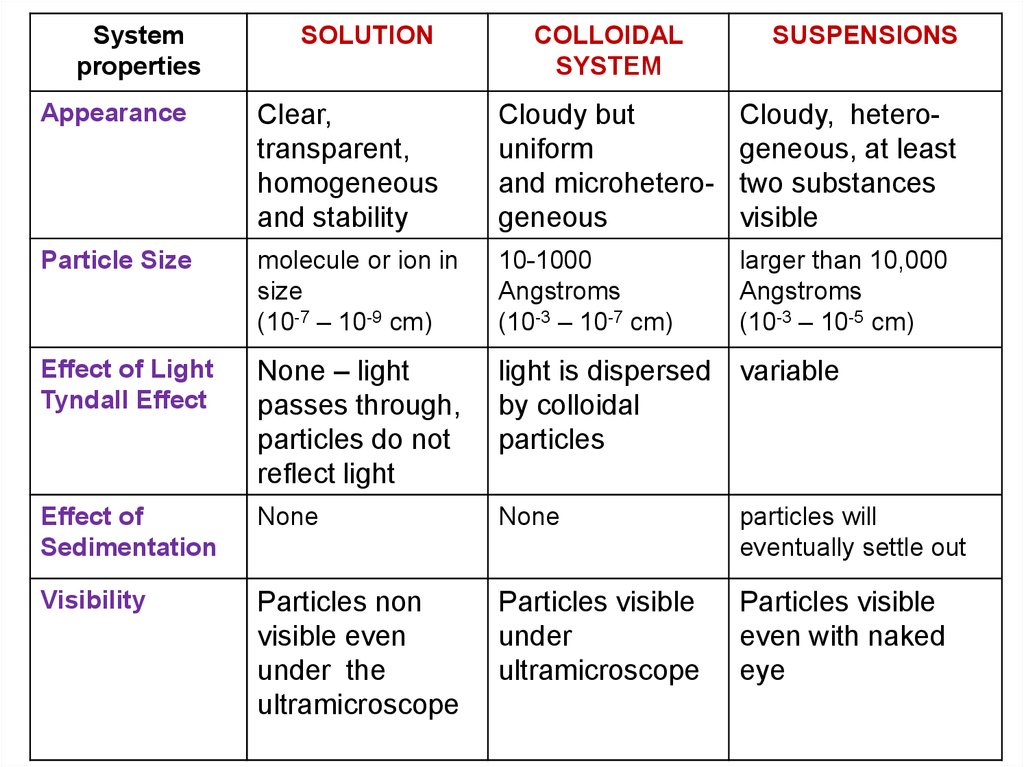
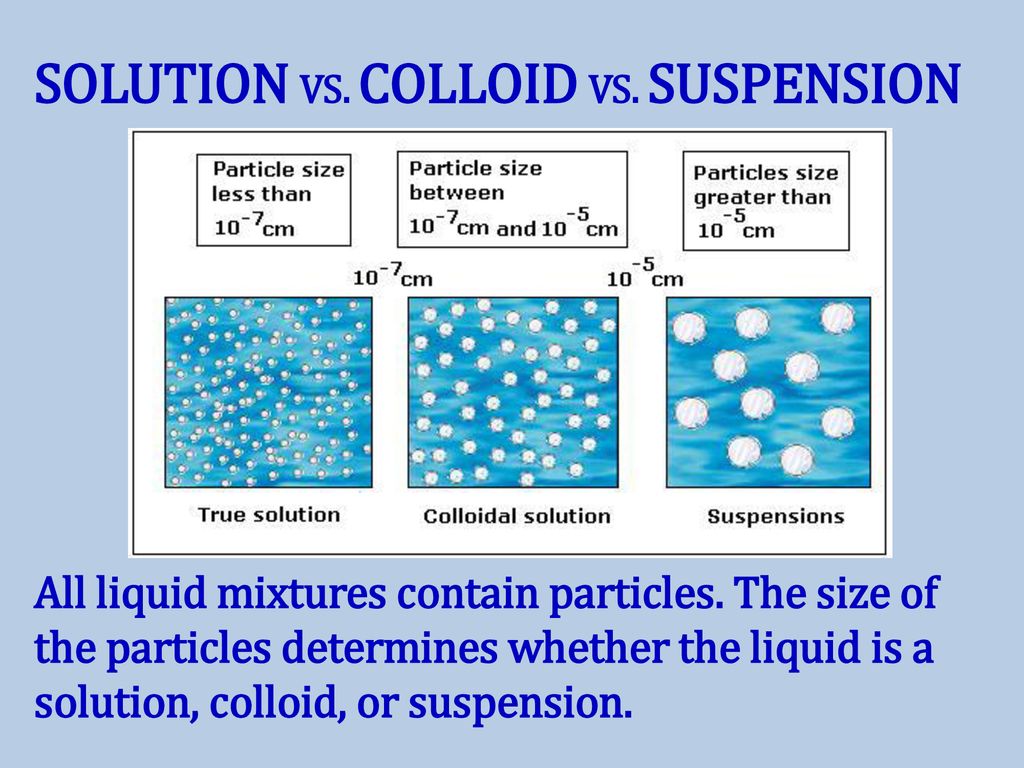
Examine these charts for further note taking.

Colloid Solutions Examples Pictures to Pin on Pinterest ...

Colloids and Suspensions | CK-12 Foundation

Solutions, Colloids, and Suspensions - ppt download


EVALUATE

ACTIVITY # 1

Quiz & Worksheet - Understanding Solutions, Suspensions & Colloids ...

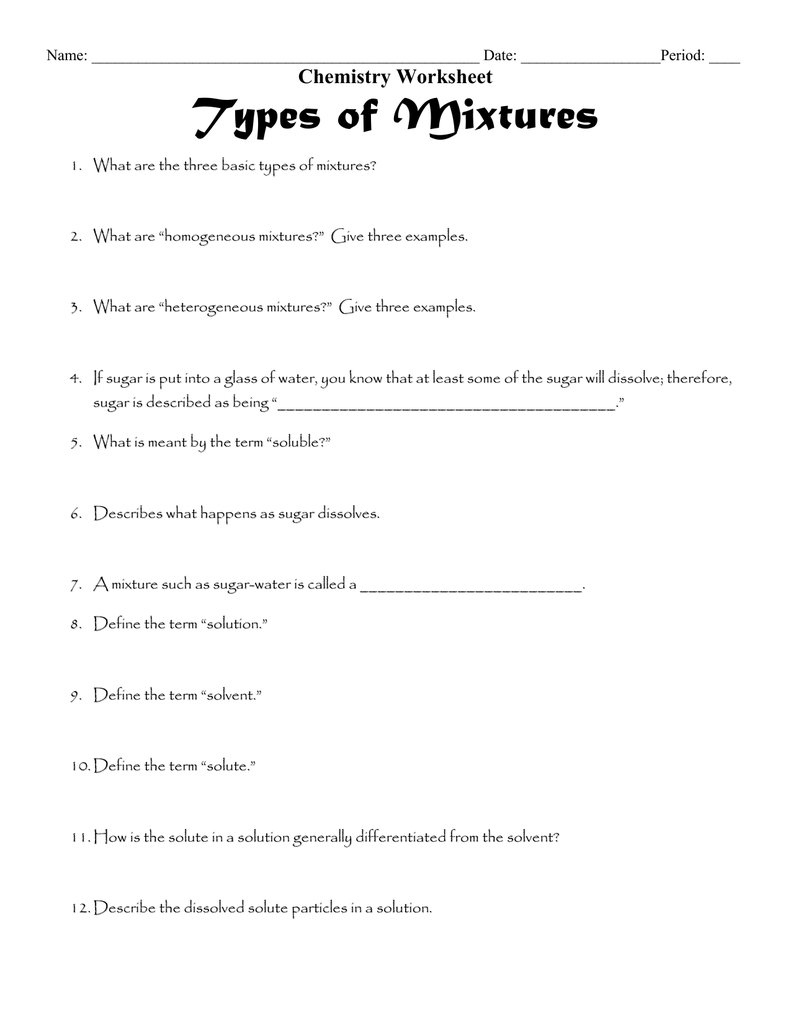
Chemistry Worksheet

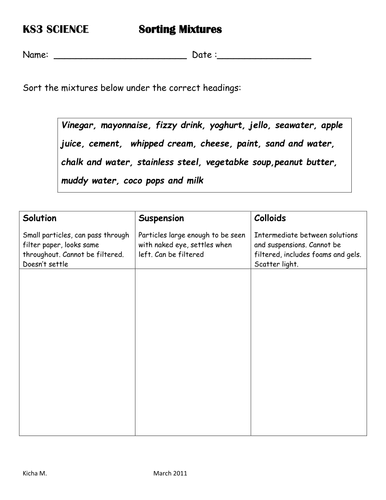
Sorting mixtures worksheet | Teaching Resources


MIXTURES - Lesson 1

FOCUS QUESTIONWhat is a mixture and how can mixtures be separated?


Specific Obj: By the end of the lesson, students should be able to:
     1.   Demonstrate that a mixture is made up of two or more       substances
   2.     Recognize that all mixtures can be separated
CONTENT

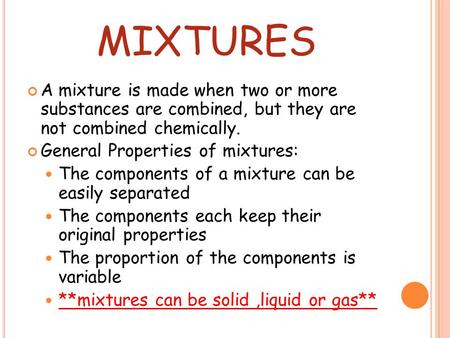
Why do we make mixtures? Mixtures have many uses: perhaps we are mixing ingredients to bake a cake, or mixing metals to make a really strong alloy. A cake is a mixture of ingredients, including flour, eggs and milk.

Many things around us occur naturally as mixtures: salty sea water, moist air, soil, compost, rocks (mixture of minerals) to name a few. Many mixtures are man-made, for instance; Coca Cola, paint, salad dressing and so forth.

Separating Mixtures. - ppt download

KEY VOCABULARYmixture, filter, filtration, evaporation, sieving, decanting, solution, colloid, suspension


ENGAGE
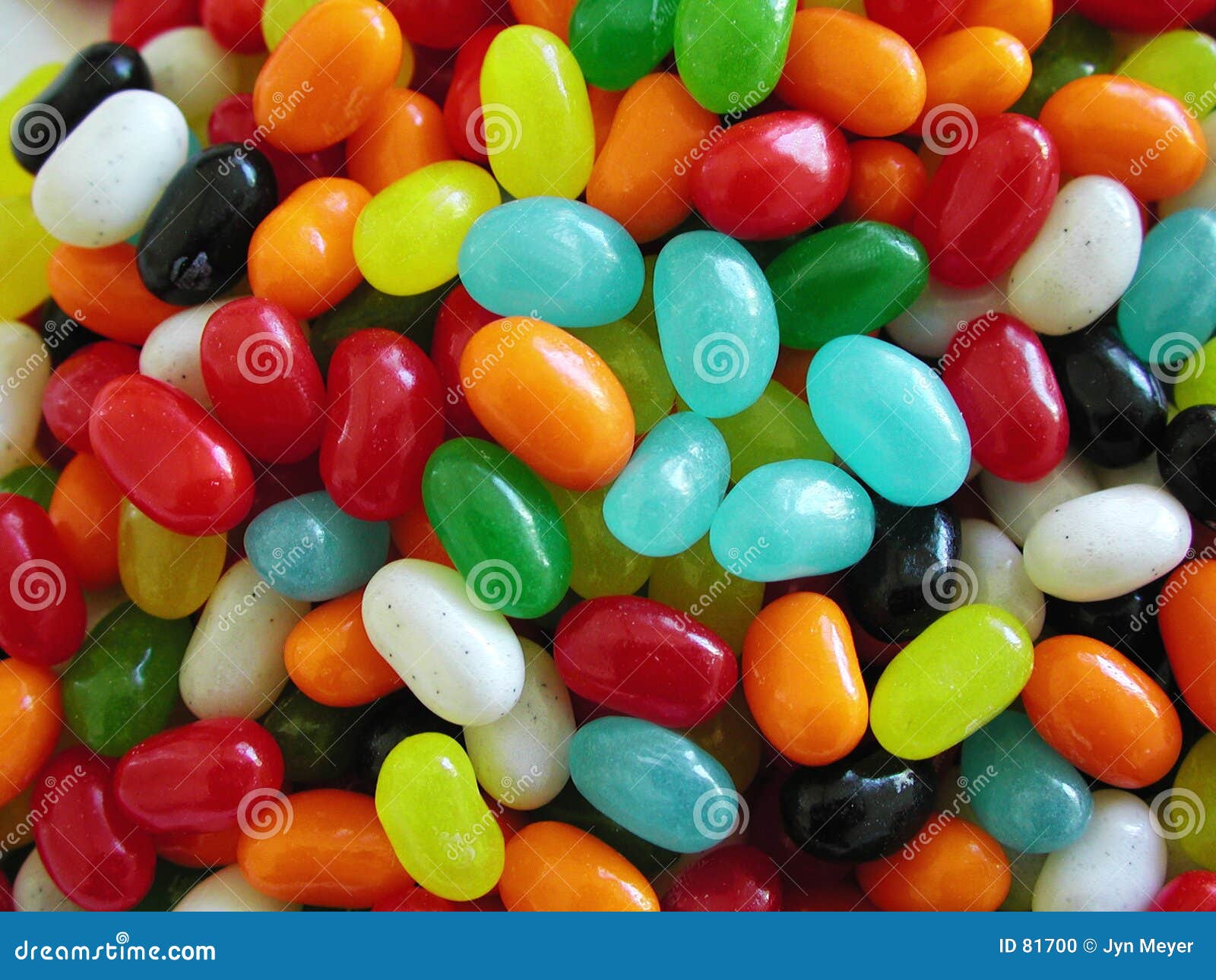
 Students I want you to try to unscramble the letters in the box below. You may use  the picture below as a clue.

M   T  R    E  I  U  X


Jelly Beans stock photo. Image of april, black, many, consume - 81700

Well your answer should be MIXTURE.
What do you think a mixture is?

How does it look?

Were you able to separate the contents you used all the time?

Did any change of colour occur?

If we are baking a cake, do we have to mix ingredients together?

EXPLORE:

(Students, I want you to get the following materials now:  1 tsp sugar, 2 tsp cooking oil, some small stones, some marbles and some water. You will also need 4 clear drinking glasses- 1/2 glass of water in each).

Ok we are going to explore what mixture is, but first, I want you to carry out some simple experiments.
1. Mix the following materials together and record what you observe. Sort the items mixed as solid-solid, solid-liquid or liquid-liquid (eg. Sugar and water is a mixture of solid and liquid).
 (A) Sugar and water
 (B) oil and water
 (C) stones and marbles


 (D) sand and rice 


Watch the video clip to lean more about mixtures.

EXPLAIN
How would you define the term mixture?
What have you noticed in each experiment?
Did all materials react the same way in the water?

EXTEND: 
Read the following to glean additional information.

Separating Mixtures. - ppt download
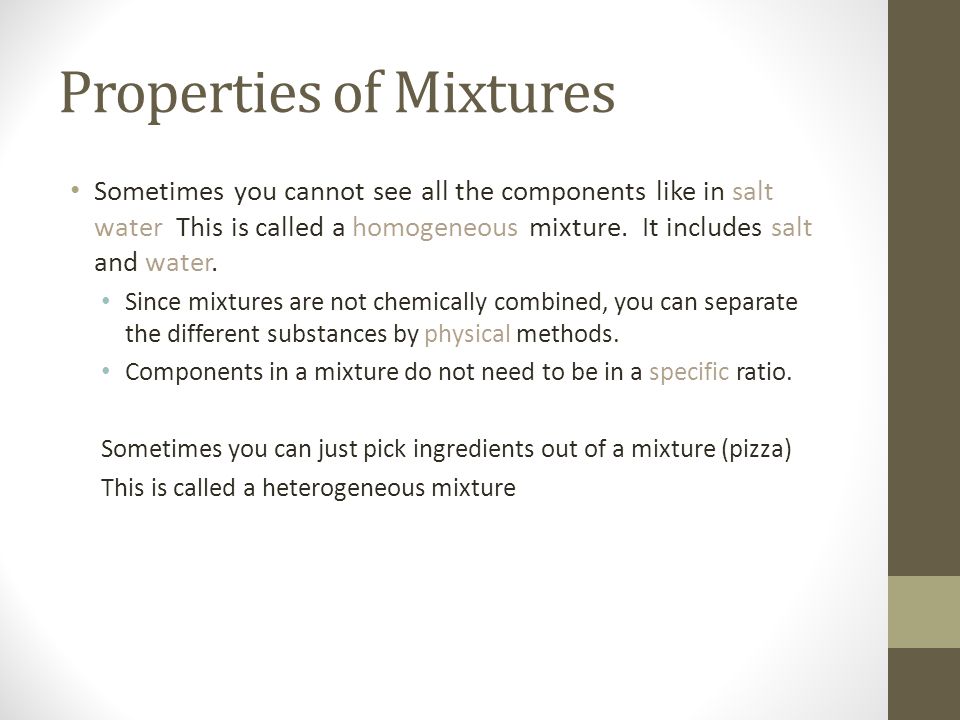
What Are Mixtures - Eschool


Elements, Compounds, & Mixtures. Objectives Describe pure ...


EVALUATE:
1. Write a simple definition for mixture.
2. Name at least 3 types of mixtures.
3. Complete the activity in this link.
4. Complete this one.


Wednesday, April 15, 2020

The Digestive System


FOCUS QUESTION:      What are some of the systems in my body and how do they work?

Content Summary

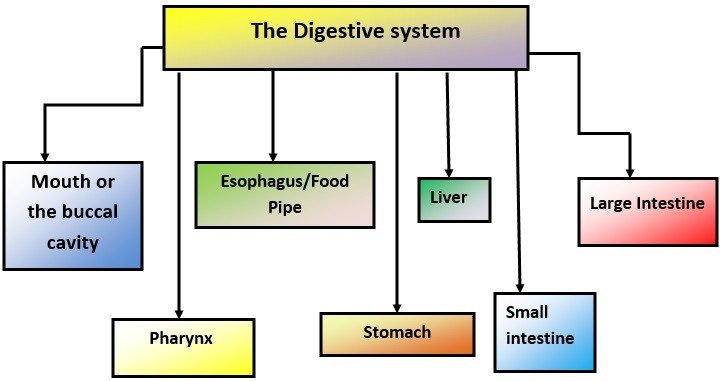
A system is a set of organs linked together and working together to carry out a set of related functions. The digestive system includes major organs like the mouth, oesophagus, stomach, small intestine and large intestine. The digestive system helps to break down food into a form that the body can find useful. Digestion is the process of breaking down food into nutrients. The digestive system is made up of a long tube called the alimentary canal, which starts at the mouth and ends at the anus. This tube is long enough to give the food sufficient time to be broken down, digested and absorbed into the blood stream.

Digestion starts when food is placed into our mouth. The teeth cut and grind the food. When it is chewed it's mixed with saliva which contains an enzyme which changes starch into simple sugar. After chewing , the food passes into the oesophagus or gullet into the stomach.
After that it moves to the small intestine. The nutrients are then absorbed through the walls of the small intestine. Undigested food passes into the large intestine in a semi -solid state then egested through the anus.


Digestive system | healthdirect

Human Digestive System 2 | eTutorWorld


This video clip will explain how the digestive system works.

Take a look at video clip number two.

EXTEND/ELABORATE
Open this link to glean more information on the digestive system.

EVALUATION:

Answer the questions  below.
      1. Name the organs of the digestive system

                2.  Where does digestion begin?

                3. What is the function of the tongue in the digestive system?

       
          4.   The list below contains the names of organs associated with the digestive system.


A.      Small intestine                  D. oesophagus
B.      Stomach                              E. mouth
C.      Large intestine                  F. anus


       Shade the letter that corresponds to the word found in the list above so that the resulting sentence is correct. Use all the options. Some options may be used more than once.
   
       Food enters our body through our   (A)¡   (B) ¡   (C) ¡   (D)¡   (E)¡   (F)¡ .  From there the food travels to the   (A)¡   (B) ¡   (C) ¡   (D)¡   (E)¡   (F)¡    through a narrow tube called the     (A)¡   (B) ¡   (C) ¡   (D)¡   (E)¡   (F)¡ .    This will then leave the    (A)¡   (B) ¡   (C) ¡   (D)¡   (E)¡   (F)¡    and enter the (A)¡   (B) ¡   (C) ¡   (D)¡   (E)¡   (F)¡.    The food like matter will move from the   (A)¡   (B) ¡   (C) ¡   (D)¡   (E)¡   (F)¡     and enter the      (A)¡   (B) ¡   (C) ¡   (D)¡   (E)¡   (F)¡  .   The waste material will then leave the body through the    (A)¡   (B) ¡   (C) ¡   (D)¡   (E)¡   (F)¡  .


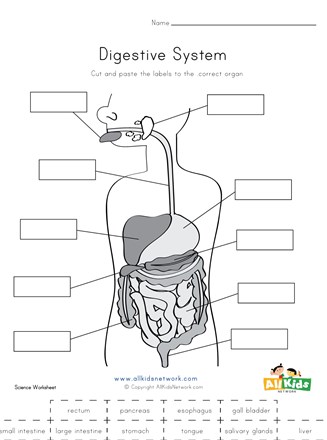
4. Open this link and label the digestive system by dragging the labels on the different organs

1
5. 

Label the Digestive System - Cut and Paste | All Kids Network


The Kidneys - Main Excretory Organs

FOCUS QUESTIONWhat are some of the systems in my body and how do they work?

CONTENT SUMMARY


The excretory system includes the kidney, bladder, skin and lungs. Substances that may be harmful to the body are removed through the excretory system.  
The main excretory organs are the kidneys. they are two in number and are bean-shaped. They produce urine .
The skin is the largest exterior excretory organ. It produces sweat, and regulates body temperature. 
The lungs take carbondioxide from the body.

Excretory System: Organs, Functions, Videos with Questions


This video clip will give you more information.

Watch this one is well.

EVALUATION:

Open this link and label the excretory system by dragging the mouse to label the organs.
5.11 Excretory System        Label the diagram correctly.

Answer the questions below.

1.       Circle the odd word in each case.

(a)    Bladder    (b) urethra    (c) heart   (d) kidney    (e) ureter

Write the reason for your selection. ______________________________________________________________________________________________________________________________________________________

(b)   (i)  Skin   (ii) lungs    (iii) heart   (iv) kidney

Justify your answer.. ______________________________________________________________________________________________________________________________________________________


2.      Explain in simple scientific language what happens in the Excretory System.

____________________________________________________________________________________________________________________________________________________________________________________________________________________________________


3.   Give the functions of the following organs.

ORGANS                                                  FUNCTIONS

 Kidney

Ureter

Urethra

Bladder

4. Complete this fun quiz.