Saturday, November 7, 2020

MATHEMATICS TOPIC: Properties of Geometric shapes (2D’s and 3 D’s) (Lesson 4) STRAND:GEOMETRY

FOCUS QUESTION
How are the characteristics of geometric solids similar and different?


SPECIFIC OBJS.
1.  Draw and describe nets of prisms
2.  Identify and create solids that are polyhedral (tetrahedron, hexahedron and octahedron)
3.Classify solid shapes (prisms, pyramids and polyhedron) according to their properties.

CONTENT SUMMARY

Solids have faces, edges and vertices.  The faces are the flat surfaces of solids. The edges are the places where two faces meet. The vertices are the corners. Singular vertex, plural vertices.

Solids are three-dimensional shapes.   A prism is a solid, with two parallel faces called bases. The other faces are always parallelograms. The prism is named by the shape of its base.  A solid is a pyramid if it has 3 or more triangular faces sharing a common vertex. The base of a pyramid may be any polygon.   An edge is formed where two faces meet.   A vertex is the point where three or more faces meet. 

3-D means three dimensional (length, breath, depth). They can be regular or irregular.

A polyhedron is a 3-D solid with flat faces and straight edges or polygonal faces. Some examples include prisms and pyramids. Cylinder and cone are not polyhedrons or polyhedral. This is so because their faces are not all polygons.

Singular polyhedron-  Plural polyhedral

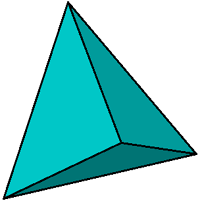
Polyhedron can be considered regular or irregular. For  them to be regular, all their faces must be equal /congruent example the cube. ( It has six equal faces and is called a hexahedron) The triangular pyramid is also a polyhedron as  it has four equal/congruent faces. (It is called a tetrahedron). Examples of irregular polyhedron are rectangular prism. (all the faces are not the same, neither are they congruent).


ENGAGE

Students will review what nets are and complete an oral exercise by identifying the solids that the nets shown represent and vice versa.

Tell what they think a polyhedron is. In groups they will try to find a working definition for same.

EXPLORE
Let us read this chart below. What is your understanding of it.


Take a look at this video clip.

EXPLAIN
Tell what polyhedra are and provide examples of polyhedra.
Explain to Tim which of the solids below are polyhedra and which aren't and why.


EXTEND/ELABORATE

Students will complete the table below in groups. Make a [ΓΌ]  for columns 3 and 4.


SOLIDS

Name

Example of Polyhedron

Not a Polyhedron

                     Justification


Cube


Square 

based pyramid


Sphere


Triangular prism


Triangular pyramid


Cylinder


EVALUATE

1. Complete the quiz below
  Quiz

2. Explain how the solids below are similar and how they are different.

Solids

            Same

                Different


cone, cylinder


Cube,         cuboid


Cube,      square-base prism


Square base prism,  sphere


           3.  Use the words below to complete the short paragraph.


                             congruent    polygonal    irregular     equal     faces   dimension

A polyhedron is a solid with flat ______________ and straight edges. All the faces of a polyhedron are______________. Polyhedra with all faces equal or ___________ are called regular polyhedra. __________ polyhedra have faces that are not __________ or congruent.


 4.  Classify the solids below as regular or irregular, polyhedra or not a polyhedron


Regular Polyhedron

Irregular Polyhedron

Not a Polyhedron


 5.       Read the statements below and indicate with a [ΓΌ] if each is TRUE or FALSE

STATEMENTS

TRUE

FALSE

A polyhedron can be a prism as well as a pyramid


For a solid to be considered as a polyhedron, then all the faces must be a polygon


A sphere is a polyhedron


The cube is a hexahedron because it has 6 faces


If all the faces of a solid are the same size, then the faces are also considered congruent


 6.  Draw a polyhedron of your choice, and label the faces, edges and vertices

 7.   Which of the following does not name the diagram below?


(a) square              (b) cube                (c) polyhedron                  (d) solid

   Justify your answer. ____________________________________________________________

8.  (a) Dwayne identified all the following solids as polyhedra. Do you agree with Dwayne? YES/NO


(b)  Justify your reason for your answer above. _____________________________________________

___________________________________________________________________________________________

 FOLLOW UP PRACTICE EXERCISES

ACTIVITY 1

ACTIVITY 2

ACTIVITY 3

ACTIVITY 5

ACTIVITY 6

ACTIVITY 7

ACTIVITY 8

ACTIVITY 9

ACTIVITY 10

Lesson Plan

Subject: Mathematics
Grade: 6
Topic: Properties of Geometric Shapes (2D’s and 3D’s)
Focus Question: How are the characteristics of geometric solids similar and different?
Duration: 1 Hour
Objectives:

  1. Draw and describe nets of prisms.

  2. Identify and create solids that are polyhedral (tetrahedron, hexahedron, and octahedron).

  3. Classify solid shapes (prisms, pyramids, and polyhedra) according to their properties.


5E Instructional Model

Engage (5 minutes)

  • Teacher displays a cube, pyramid, and cylinder (real objects or 3D models).

  • Ask: “What do you notice about these shapes? How are they alike? How are they different?”

  • Show a short 2-minute animation (or digital model) of nets folding into 3D solids.

  • Record students’ initial ideas on the board.


Explore (15 minutes)

  • Students work in small groups with nets of different solids (cube, rectangular prism, pyramid, tetrahedron, octahedron).

  • Task: Cut, fold, and build the nets into 3D shapes using card stock or paper.

  • Groups observe and discuss: “How many faces, edges, and vertices does each shape have?”

  • Teacher circulates, prompting with questions such as:

    • “What polygons make up the faces?”

    • “Which solids are polyhedra? Why?”

STEM Connection: Students use geometric modeling (math) and hands-on engineering (building nets → structures). Link to real-world: architects and engineers use nets and models to design buildings.


Explain (10 minutes)

  • Each group shares findings: differences between prisms, pyramids, and polyhedra.

  • Teacher introduces and clarifies definitions:

    • Prism: 2 parallel, congruent bases + rectangular faces.

    • Pyramid: 1 base + triangular faces meeting at a point.

    • Polyhedron: solid with flat polygonal faces (tetrahedron, hexahedron, octahedron).

  • Reinforce Euler’s formula (V – E + F = 2) as a property of polyhedra.


Elaborate (20 minutes)

  • Activity:

    • Groups classify solids provided (cube, prism, tetrahedron, octahedron, pyramid, cylinder, cone, sphere) into prisms, pyramids, polyhedra, or non-polyhedra.

    • Students explain reasons for classification.

  • Extension: Challenge students to design their own net for a new prism or pyramid and predict the 3D solid it would form.

Differentiated Learning:

  • Tier 1 (Support): Work with pre-drawn nets, teacher guidance.

  • Tier 2 (On Level): Draw and build their own nets with minimal guidance.

  • Tier 3 (Advanced): Apply Euler’s formula to verify solids and create irregular nets.


Evaluate (10 minutes)

Three-Tier Evaluation:

  • Tier 1 (Recall / Identify):
    Match given nets to their correct 3D solids (cube, rectangular prism, pyramid).

  • Tier 2 (Application):
    Draw and describe the net of a triangular prism or square pyramid.

  • Tier 3 (Reasoning / Extension):
    Use Euler’s formula (V – E + F = 2) to prove whether a given solid is a polyhedron.

Students present answers orally or in writing.


Closure (5 minutes)

  • Revisit focus question: “How are the characteristics of geometric solids similar and different?”

  • Emphasize: All solids have faces, edges, and vertices, but their arrangement and types of faces classify them.

  • Quick reflection: “Which solid would you use if you were an architect designing a roof? Why?”


✅ This plan balances hands-on exploration, STEM integration, real-world connections, and differentiation while hitting all three objectives.


Friday, November 6, 2020

Thursday, November 5, 2020

The Writing Process - Language Arts Strand: Writing

 FOCUS QUESTION

What was Jamaica's Road to independence?

SPECIFIC OBJS.
Review the strategies of the writing process (pre-writing, drafting, revising, editing and publishing)

CONTENT SUMMARY


ENGAGE

Students what do you recall about the WRITING PROCESS? Let us revise the stages together.


What is each stage about?  Let us read the chart below.
There is a mnemonic you can use to help you remember them in order: P-DREP

EXPLORE


Now you are going to write about Marcus Garvey. What are some things that we could write about him?

Ok, let's say we all want to write about "Marcus Garvey and his contribution to Jamaica".

Let's brainstorm to see how we could use these stages to write about him. 

What type of writing would this be?

Indeed it would be an EXPOSITORY piece.

Pre-Writing 
What are some things you would want to write about Marcus Garvey?
Who will be your audience?
(Use the questions in the pre-writing stage as a guide).

Drafting
Now jot down your ideas in this stage.
Remember they do not necessarily have to be in any order.
You can also use a graphic organizer at this stage.

Follow the other stages to complete the task.


EXPLAIN
Explain what the steps in the writing process are.

EXTEND/ELABORATE
You can watch the video clip below to glean more information on the topic. Be sure to make your notes.

EVALUATE

Prepare the following for publication and submission.

"Marcus Garvey and his contribution to Jamaica".
Be sure to include the following:
*His birth date
*Place of birth
*Status
*His occupation
*Famous quotes
*Contribution towards achievement of Independence in Jamaica


Tuesday, November 3, 2020

TOPIC: Scale Drawing Maths - Strand: Measurement


FOCUS QUESTION
How do I calculate and use the various measurements around me?

SPECIFIC OBJS.
Interpret a simple scale drawing and calculate actual distances using the scale on a road map or floor plan.

CONTENT SUMMARY

In plain English, a scale drawing is a drawing which has been reduced or enlarged from its original size, to a specified scale. The scale is a ratio of the size of the drawing to the size of the original object being drawn. This may be referred to as a scale ratio.


ENGAGE
Students. I want us to all turn to the Map of Jamaica. 
Before we go any further, what are the four things found on a map?

Title
Compass
Key
Scale

Now look at what the scale says. 
I want you to use your ruler and measure the distance between the following places in cm.
Black River to Santa Cruz
Santa Cruz to Christiana
Portmore to Harbour View

Do you believe the distances you got for these places could be the actual distances of these places?
Of course not. The real length of these places could never hold in this Atlas.

This is why we need what is called a SCALE to represent these actual lengths.

We will be looking today at SCALE DRAWING.


EXPLORE
Let us listen to the video clip on scale drawing below, to learn more about it.

Video clip: Scale Drawing

In SCALE DRAWING, the first term refers to the length of the scale and the second term refers to the length of the actual object.


Now let us go back to the places you measured earlier on. 
Using a scale of 1cm = 30 Km , find the actual distance of each place.

 PLACES                                                                    

 MEASUREMENT    

ACTUAL DISTANCE 

 Black River to Santa Cruz

 2.5 cm


 Santa Cruz to Christiana

 3.5 cm


 Portmore to Harbour View

 3    cm


EXPLAIN
What is meant by SCALE DRAWING?
Explain what the first and second term on the scale  of a map represent.
When in other real life situations is scale drawing used?

EXTEND/ELABORATE

Use your ruler and the scale below to answer the questions that follow.
By now you should have noticed that one box in the grid actually represents 1 cm.


(a) What is the actual distance from Super Shop to Hotel Sun?
(b) What is the actual distance between Beach Bistro to Grooves Night Club?

EVALUATE
1. The distance between two towns is 8 cm. Using a scale of 1cm: 500 km, calculate the actual distance between the two towns.

2. Complete the table below, using the scale 1cm: 20 km.

Places

Measurement

Actual Distance

Kingston to Morant Bay

       20 cm


Santa Cruz to Christiana

         3 cm


Black River to Lacovia

         2 cm


3. 


FOLLOW UP PRACTICE EXERCISES

ACTIVITY 1

ACTIVITY 2

ACTIVITY 3

ACTIVITY 4

5E Mathematics Lesson Plan – Scale Drawing

Grade: 6
Duration: 1 hour
Topic: Scale Drawing
Focus Question: How do I calculate and use the various measurements around me?
Objective: Students will interpret a simple scale drawing and calculate actual distances using the scale on a road map or floor plan.


Engage (5 mins)

  • Activity: Show students a Google Maps screenshot of a familiar area (school neighborhood) with a scale bar.

  • Prompt Questions:

    • What does this small line at the bottom mean?

    • Why do maps use a scale instead of the actual size?

  • Mini-discussion: Highlight real-life situations where scale drawings are used—blueprints, road maps, furniture layout.

  • STEM Connection: Explain that engineers, architects, and surveyors use scale drawings to represent real structures accurately.


Explore (10 mins)

  • Activity:

    1. Give students a simple floor plan of the classroom (1 cm = 1 m).

    2. Students measure a few distances on the plan (e.g., door to window, teacher’s desk to board).

    3. They convert measurements into actual distances using the given scale.

  • Group Work: Students work in pairs with rulers and compare answers.

  • STEM Link: Relate to how builders check actual building dimensions from blueprints before construction.


Explain (15 mins)

  • Direct Teaching:

    1. Define scale and scale drawing.

    2. Explain the two main scale types: ratio form (e.g., 1:100) and word form (e.g., 1 cm represents 1 m).

    3. Show step-by-step:

      • Measure drawing distance.

      • Multiply by the scale factor to get actual distance.

      • Reverse: Divide actual distance by scale factor to get drawing size.

  • Example Problem:
    A map scale says 1 cm = 5 km. The distance between two towns is 8 cm on the map.

    • Actual Distance = 8 × 5 = 40 km.

  • STEM Link: Discuss GPS devices and mapping software that apply scale conversions automatically.


Elaborate (15 mins)

  • Activity – "Plan My Room"

    1. Students receive a mini floor plan of a bedroom with some distances labeled.

    2. They calculate actual distances.

    3. Extension: Students create their own mini plan of their dream bedroom at a chosen scale (e.g., 1 cm = 0.5 m).

  • Differentiation:

    • Tier 1 (Support): Provide scale already written and guide through calculations.

    • Tier 2 (Core): Students calculate with given scale and unlabeled distances.

    • Tier 3 (Challenge): Students choose their own scale and convert between different scales.


Evaluate (15 mins)

Three-Tier Evaluation Activity

  1. Tier 1 (Basic Understanding):

    • Given: Scale 1 cm = 2 km.
      Q: If two points are 6 cm apart on the map, what is the actual distance?

  2. Tier 2 (Application):

    • Given a simple road map, measure two towns 4.5 cm apart. Scale 1 cm = 3 km.
      Q: What is the actual distance?

  3. Tier 3 (Reasoning & Extension):

    • A playground is 40 m long in real life. You want to draw it on paper so that it’s 8 cm long.
      Q: What is the scale of your drawing?

  • Rubric:

    • Mastery: Correct use of scale factor in all tasks.

    • Proficient: Minor calculation error but correct method.

    • Developing: Needs help identifying correct scale usage.


Closure (5 mins)

  • Recap: Why do we use scales? How do we find actual distances from drawings?

  • Real-world link: Assign students to find a map at home or online and identify its scale for next class.


Materials Needed

  • Rulers

  • Printed maps/floor plans

  • Pencils, erasers

  • Google Maps screenshot with scale bar